

The Concept Layer
Status: partly built
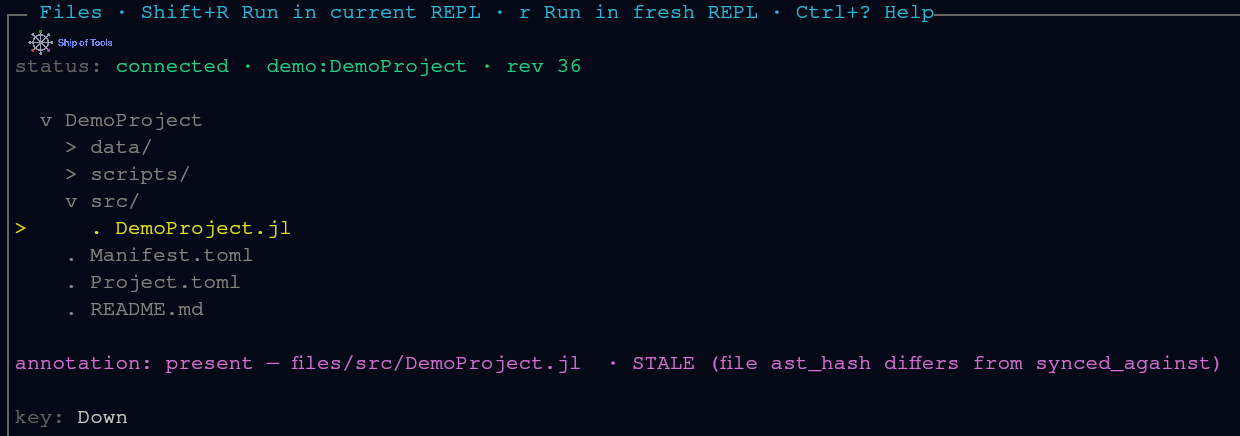
Built: .concept/ annotations are read from the window, their prose can be edited there, and the annotation of a .jl file shows stale when the file's hash differs from its synced_against. Not built: per-entity staleness, the one-key refresh (the window cannot re-stamp synced_against), a drift check for files that are not .jl, and verification of references.
The concept layer is what makes Ship of Tools a concept explorer rather than a file browser. It is prose — intent, contracts, meaning, math — attached to the units of a Julia project and kept honest against the code those units describe. The LLM is the primary author and maintainer of this layer; the user can edit it too.
It is built from two layers with very different update mechanics. Keep them separate in your head:
| Layer | Source | Currency | LLM involved? |
|---|---|---|---|
| Structural | parsed mechanically from code via JuliaSyntax.jl | always current | no |
| Annotation | LLM- or user-authored prose attached to nodes in the structural layer | can drift | yes |
The structural layer is derived, never stored as a fact you can get wrong — it is recomputed from the source. The annotation layer is the part that can fall out of sync, so the whole design below is about detecting and surfacing that drift rather than trying to prevent it.
The .concept/ sidecar
Annotations live in a sidecar .concept/ directory at the project root. The window asks for exactly two forms:
.concept/
  files/src/foo.jl.md     # the annotation for src/foo.jl: its path under files/, with .md appended
  modules/MyModule.md     # the annotation for the module MyModule in Modules mode
Nothing reads any other path. The layout the design describes for more kinds of node is not built, and an annotation written there is never shown:
.concept/                       # design, not built
  project/intent.md
  types/MyModule/MyType.md      # Types mode
  functions/MyModule/myfunction.md
  math/geometry/rotation.md     # Math mode
The directory is plain files on disk. That is deliberate: it survives a restart, diffs cleanly in git, and is readable without Ship of Tools running. The annotation for a node in Files or Modules mode is always at a predictable location.
Frontmatter
Each annotation file carries YAML frontmatter that ties the prose to the entity it describes and records when it was last reconciled:
target: MyModule.MyType
target_kind: type
synced_against: <file hash>
synced_at: 2026-01-15T14:30Z
authored_by: an agent | the user
references:
  - MyModule.method1
- math/geometry/rotation| Field | Meaning |
|---|---|
target | the entity this annotation describes |
target_kind | what kind of entity (type, function, module, …) |
synced_against | the content hash of the target's file at the last reconciliation |
synced_at | timestamp of that reconciliation |
authored_by | free text, an agent or the user; nothing reads it today (the provenance coloring it is meant to feed is not built — see Color Coding) |
references | links to other entities or annotations (verification is planned — see below) |
The load-bearing field is synced_against. It is the hash of the target's file as of the last time the annotation was confirmed accurate. Staleness is just a comparison: take the file's hash now, and if it differs from synced_against, the prose was written against an older version of the code. Today synced_against is the only field the backend parses; the rest of the frontmatter is preserved verbatim across edits and shown above the editor, but is not otherwise acted on.
The staleness hash
What is built is a file-level hash. The kernel's file.parse reply carries an ast_hash field that is the SHA-256 of the file's bytes, rendered as the full 64-character hex digest. Despite the field name, nothing is parsed to make it, so any change to the file — a reformat, a comment, a docstring — changes the hash, and one hash covers the whole file, however many entities it declares.
The window keeps that hash per file and compares it with the synced_against of the annotation for the file (target files/<path>). The daemon parses only synced_against out of the frontmatter, and gates a concept write on it: a save carries the synced_against the editor opened with, and the daemon refuses the write if the annotation on disk has moved on.
NOT BUILT: the per-entity hash
ADR 0005 (docs/adr/0005-ast-hash.md) specifies a hash of the targeted entity's parsed syntax tree, with trivia skipped, so that reformatting does not mark an annotation stale while a structural edit does, and so that an edit elsewhere in the file leaves it alone. That contract is not built. The kernel does compute a per-definition ast_hash of that shape in its definition lists (file.parse definitions, project scans), but nothing compares those values with synced_against and no annotation is keyed to a single definition.
Update lifecycle
Drift detection is reactive — Ship of Tools surfaces it, you fix it when you choose to:
You save a file. (Either you edited it, or an agent did.)
The window asks the kernel for the file's hash (
file.parse) when the cursor reaches the file's row in Files mode, and keeps it until the file changes on disk; the next view after a change asks again. After an edit the annotation line shows "checking…" and then STALE, at the next view with the cursor on the file (nothing sweeps in the background); after a reconcile it reads the annotation again and shows "in sync". No restart is needed. Only.jlfiles are hashed: the status line for the annotation of any other file stays at "checking…" and never shows STALE.The annotation is marked stale when the hashes differ. The comparison is
file_hash != synced_against, made for the annotation of the file under the cursor.The stale annotation renders yellowed on the file's row while the cursor is on it, and in the annotation status line. See Color Coding.
Not built: per-entity staleness (a changed entity marking only its own annotation stale) and the badge in every mode. Both rest on the per-entity hash above.
There is no background sweep. Nothing recomputes annotations on a timer or refreshes them behind your back. Visible drift is the feature: a yellowed badge tells you the prose may no longer match the code.
Reactive refresh
The intended model is reactive: navigate to the stale annotation and trigger a refresh with a single keypress that re-stamps synced_against (and synced_at) to the file's current hash, marking the prose as reconciled against the present code. You stay in control of when — a refresh asserts the annotation is still accurate, so it is a deliberate act, not an automatic one.
That one-key re-stamp is not built, and the window cannot re-stamp an annotation. e on a file with an annotation edits the prose only: the frontmatter shows read-only above the editor and is saved unchanged (Ctrl+S saves; Esc with unsaved edits asks before it discards them). So an annotation still shows STALE after you save it in the window. To reconcile one, an agent or a script writes the file's current hash into synced_against in .concept/files/<path>.md. That hash is the SHA-256 of the file's bytes, as 64 hex digits (what sha256sum prints).
Reference verification (planned)
The references list links an annotation to other entities (MyModule.method1) or to other annotations (math/geometry/rotation). A background pass that verifies these links after every re-index is planned: when a referenced entity no longer exists — a method was deleted, a derivation renamed — the link would be broken, and the annotation marked stale on that basis too, keeping the concept layer internally consistent, not just consistent with code. Today the references field is preserved on disk but not verified.
See also
- Color Coding — how staleness and authorship render across modes.