

Previews
When you cursor a file in any mode, the preview pane renders it at the fidelity appropriate to its type. The backend first asks the Julia kernel: a FileType plugin claims the path with matches and returns a PreviewPayload from preview. When no plugin claims it, the backend reads the file itself; that is how raster images and plain text are served. The payload's mime tells the frontend which renderer to use; the bytes are opaque to Rust. Adding a format is a Julia-only change — see The Dispatch ABI and Writing a FileType Plugin.
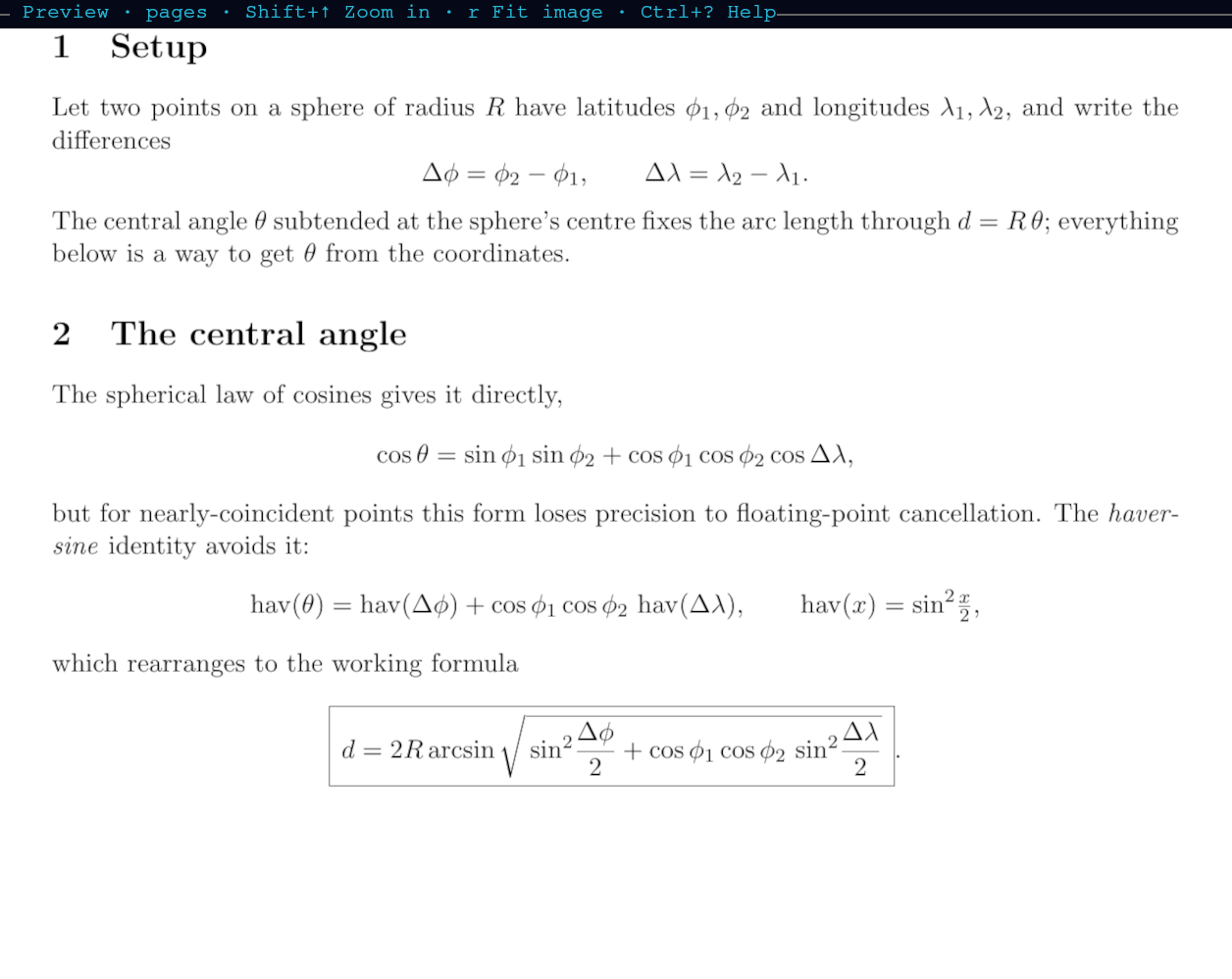
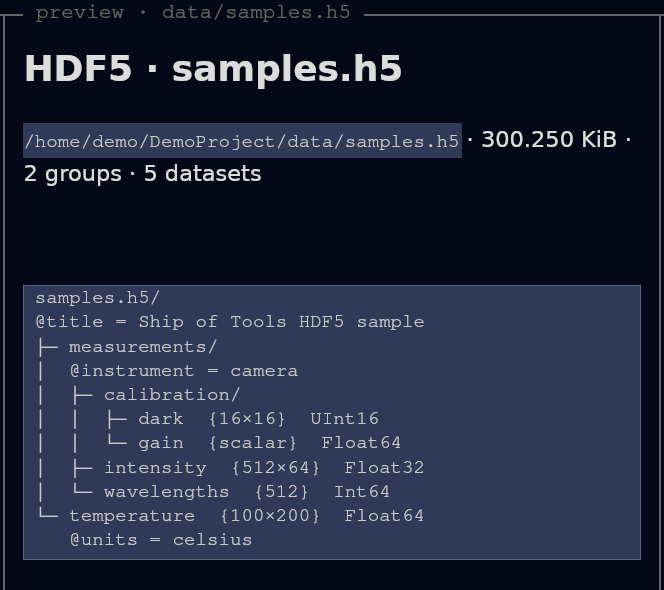
Built-in file types
These plugins ship under julia/plugins/ and the kernel loads them at startup. Each is a built-in that travels the exact same dispatch path a third-party plugin would.
| Extension | Representation | Fidelity |
|---|---|---|
.jl | token spans (kind + text) from JuliaSyntax.jl | syntax-highlighted source, no client-side re-tokenizing |
.md, .markdown | raw UTF-8 bytes | rendered markdown (comrak + cosmic-text), including inline math |
.toml | raw UTF-8 bytes | code/text renderer |
.json | raw UTF-8 bytes | plain text today (pretty-print / colour planned) |
.txt | raw UTF-8 bytes | plain text renderer |
.pdf | one poppler-rasterized page | paged; n/p turn pages with the preview focused, rasterized backend-side to fit the pane |
.mp4, .webm, .mov, .mkv, .m4v | a single ffmpeg poster frame | still poster in the pane; o opens playback in the browser |
The plugin module and MIME type behind each row are listed under Built-in preview plugins.
PNG (and other raster images) render directly through the frontend's image quad path — the same path the PDF and video plugins reuse by returning image/png.
A few notes on the table:
Julia source is tokenized on the kernel side into
{spans: [{text, kind}]}, so the frontend colours it without parsing Julia. The token kinds map to the frontend's colour set (keyword,comment,string,number,op,punct,type,ident,text); concatenating every span reproduces the file byte-for-byte.PDF is the one format whose preview takes a page parameter — the only built-in that addresses which part of a file to render. Pages rasterize on the host where the file lives (poppler's
pdftoppm/pdfinfo), matching the backend-side-decode model.Video deliberately does not play in the pane. A native player (HTML5
<video>with hardware decode) beats streaming decoded frames over a socket, so the pane shows a poster andopops the real file out to the browser.
When an external tool is missing (ffmpeg for video, poppler for PDF), the plugin returns a text/markdown note explaining the gap — never a silent blank pane.
Opens in the browser, not the pane
Some formats are interactive HTML and belong in a real browser rather than a static pane. Consistent with the video policy, these are popped out to the OS browser through the backend connection, local or remote, rather than rendered in-pane:
HTML (
sample.html) — opened in the browser, with the figure and movie beside it served by the daemon's page server, so a missing one shows the page path dropped it.Pluto notebooks (
pluto_demo.jl,pluto_demo2.jl) — opened as live Pluto sessions in the browser. As.jlfiles they still get a syntax-highlighted source preview in the pane.Quarto documents (
quarto_julia.qmd) — the rich rendered form opens in the browser; the source previews as text in-pane. On Linux the Julia engine server a render starts ends when the backend daemon ends; aquarto renderof your own that found and reused that server (Quarto finds it throughXDG_RUNTIME_DIR) starts a new one after that.
These all follow the same "rich/interactive content lives in the browser" policy.
A page that acts
A page opened by W or sot-fe docs can read session states and act on rows of the daemon serving it. Its script posts JSON to its own URL:
const response = await fetch(location.pathname + location.search, {
  method: "POST",
  headers: {"Content-Type": "application/json"},
  body: JSON.stringify({verb: "states"})
});
const answer = await response.json();
states answers {ok: true, rows: [...]}, sorted by handle, including sessions outside rows. Each entry has handle, host, repo, row, state, summary, question, options (objects with key and text), recommend, page, waiting, status_at and last_seen. An absent string is empty, and row is empty for a session outside any row. A question's Options:, Recommend and Page: parts are separated into those fields. Only this daemon's host entries are listed. An unreadable or damaged registry answers 500 handler_error; an empty rows array means a successful read found no sessions of this daemon.
Post {verb: "goto", handle: "session-handle"} to switch the window that opened the page to that row. Post {verb: "open", handle: "session-handle"} to open the page the row's question names. The daemon reads the question again and requires an absolute page under that row's project folder. It grants a site rooted at that row and checks each file request there. Unix grants hold the row folder by identity and open files relative to that held folder; Windows retains a path-based check/open race. The page script supplies a handle; it cannot select an arbitrary file. These actions need no confirmation and answer 202 with {ok: true}. They go to the page's own window even when another window is in use, locally and through a remote window's page proxy. {verb: "open", handle, embed: true} instead answers 200 with {ok: true, url}, a path on the calling page's own origin for an <iframe>, and opens nothing: the framed page can be read but cannot answer, and a page keeps one embed at a time, so a new one replaces the last.
Replies are JSON and never cached. A refusal has error (the explanation) and code: not_a_row (409, including a foreign session, whose daemon is named), no_page (409), page_outside (403), or window_gone (503). States still works while the window is away. Missing fields, malformed JSON and unknown verbs answer bad_request (400). Post {verb: "reply", handle: "session-handle", text: "approve"} to answer that session. Text trims ASCII spaces, must be nonempty and fit in 512 UTF-8 bytes, and must contain no controls, line separators or invisible formatting characters. Invalid text answers 400 bad_text, naming the refusal. Accepted text gains the visible [sot-page] mark. Only a page opened with a reply scope answers: sot-fe docs --direct gives a session's own page its row, --direct-all gives a list page every row, and a question's page opened by open answers its own row. Such a reply is typed at once at the session's free prompt, or held until the prompt frees, and answers 200 with its receipt: sent, held, refused with the reason, or unknown. A page opened without a scope is refused, 403 no_reply_scope, and nothing is typed or offered anywhere. Every reply leaves one line in the daemon's log, whatever became of it.
The typing rechecks the mark and the target handle and uses the wake's free-prompt gate, sharing one typing attempt per row. It refuses a dialog, a menu, unsent text a person typed and an unsupported agent, and holds a reply for a working screen or a running Stop hook; only a Ready Claude capsule row is supported. A line wider than the pane wraps and is checked across its rows before Enter. A sent line carries the mark in the pane and the transcript. typed_not_sent means text was typed but Enter withheld, and unknown means delivery could not be confirmed; inspect the pane before trying again. An unsent page line is never completed by the wake. A card answer counts as the person's word, a merge, a tag or a registration in General included, behind the card's acknowledgment of what it does. The mark is not proof of physical keyboard input, since existing pty.input callers can type text.
The channel requires the site's live nonce or explicit pool query secret and a matching browser Origin. Keep location.search in a pool page's POST URL: cookies alone do not authorize verbs, since another open may replace the browser's cookie while an old tab remains. Other origins and requests without Origin are refused (403); OPTIONS cannot authorize a cross-origin request (405). POST bodies need a Content-Length and fit within 4 KiB; valid requests reuse their connection for polling. The last eight prefix pages opened by a window keep working, so a queue page can open a decision page and keep polling. A site with root-relative links uses a pool port instead, with one site per window: opening another pool site replaces it. Decision pages opened by a verb must use relative paths for assets and navigation, such as assets/app.js; root-relative paths such as /assets/app.js are unsupported and normally return 404. All page listeners share separate budgets of four body readers, four states handlers and four action handlers; stalled actions cannot consume polling slots. Excess requests answer 503 server_busy. A handler exceeding five seconds answers 503 handler_timeout; stalled blocking work keeps its class's slot until it ends. These errors have the same JSON error and code fields and can be shown by the page.
The fixture at rust/backend/tests/fixtures/page_channel/index.html lists states every three seconds and provides Go to, Context and reply controls for checking the channel in a local or remote window.
A page can also show data that lives outside its repo. When the repo tracks a symlink to a folder on a mounted share or drive (under /mnt, /media or, on macOS, /Volumes), images and movies on the page load through that link, and movies seek; nothing needs to be declared. Write the link as the share's absolute path, as ln -s /mnt/<share>/... <name> does: a relative target, or one that runs through another link or a .., is refused, and so is a symlink inside the share: a link serves only the files directly under its target folder, by their own names. A file in your home folder, or with a folder or name below the mount folder, on the file's real path, that starts with ., is never served through a link (a link itself named .data still serves). Anything else is refused with a message saying why, which the browser shows when the missing file is opened in a tab of its own: a link git does not track (git add it and reload), a linked file that is not under those folders or does not exist on the computer whose daemon serves the page (is its share mounted?), a link to /, to your home folder or the repository or a folder inside it (in any letter case), to a link whose target is not written as the share's absolute real path, a .. in the path, .git, a repo file outside the page's site folder (the outermost folder above it, within its repository, that holds an index.html), or a file that changed while it was being opened. On macOS, following a link needs git, which means the Command Line Tools; the daemon picks up tools installed later at its next restart. On Windows no link is followed, so a page there never shows linked data.
Pan and zoom images
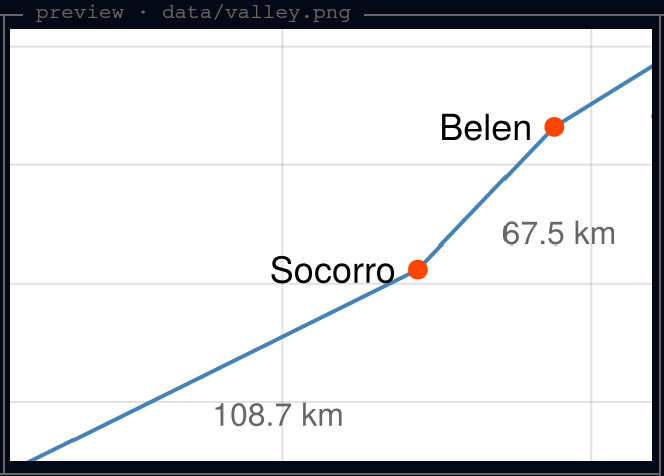
With the preview focused (Ctrl+Right), = zooms an image in and the arrow keys pan it. Same-size images in a directory share zoom and pan, so stepping through a run's plots keeps your framing.
Capturing a preview region for the LLM
For raster image previews you can zoom in, then, with the preview focused (Ctrl+Right), press c to crop the visible region and hand it to the session's agent in the agent pane, with a question such as "what's the artifact here?". The crop is taken from the source image on the backend and delivered to the agent, so it sees exactly the region you are looking at.
Formats added by external plugins
File types do not have to be built-in. The HDF5 worked example ships as a separate package and claims .h5 (see the sample.h5 fixture) with no Rust changes. It is a dependency of the kernel's environment and is registered in the kernel's lazy-load table (LAZY_PLUGIN_FOR_EXT), which loads it on the first .h5 preview.
Adding a new file type
A FileType plugin is small: a subtype, a matches predicate, and a preview that returns a PreviewPayload with the right MIME.
module CsvPreview

using ConceptExplorerCore

struct CsvFile <: FileType end

ConceptExplorerCore.matches(::Type{CsvFile}, path) =
    endswith(lowercase(path), ".csv")

function ConceptExplorerCore.preview(::Type{CsvFile}, path)
    lines = readlines(path)
    ncols = length(split(lines[1], ","))
    table = String[]
    for (i, line) in enumerate(lines)
        push!(table, "| " * replace(line, "," => " | ") * " |")
        i == 1 && push!(table, "|" * repeat(" --- |", ncols))  # header rule
    end
    PreviewPayload("text/markdown", Vector{UInt8}(join(table, "\n")))
end

end
The plugin runs in the kernel, not in your REPL: add the package to the julia/kernel environment (Pkg.develop or Pkg.add), then add it to the kernel's using list or map its extension in LAZY_PLUGIN_FOR_EXT. Today that works only from a source checkout. No Rust change is needed. See Discovery for what loads today. For the full contract and discovery rules see The Dispatch ABI and Writing a FileType Plugin.